
![Canadian Innovation Architects: Top 10 Firms Reshaping Business Landscapes [2025]](https://pearllemonconsulting.ca/wp-content/uploads/2025/07/Canadian-Innovation-Architects-Top-10-Firms-Reshaping-Business-Landscapes-2025.webp)
An innovation consulting company solves a different problem than a strategy firm, a management consultancy, or a technology partner. Where those three set direction, redesign operations, and build systems, an innovation consulting partner answers a narrower but harder question: what new product, service, or business model should this company build next, and how do we test it before spending real money on it. That covers design thinking, new product development, business model design, and the prototyping work needed to turn a rough idea into something a customer would actually pay for.
Innovation Consulting and Implementation in Construction
Construction innovation consulting is valuable when the brief goes beyond brainstorming and needs implementation across field operations, estimating, procurement, project controls, data, sustainability or new construction technology. Buyers should look for a partner that can test the commercial and operational case, pilot the change on a defined workflow or project, and measure whether the innovation improves cost, speed, safety, quality or delivery reliability before scaling it.
Research methodology: See how we evaluate and compare consulting firms.
Business Innovation Consulting: What It Should Solve
Business innovation consulting helps companies decide what to build next and how to test it before committing full budget. Typical work includes new product and service concepts, business model design, customer research, experimentation, prototyping and the operating process needed to move an idea from workshop to launch. The useful distinction is that innovation consulting should reduce uncertainty with evidence rather than simply produce more ideas.
Innovation Consulting in Toronto, Calgary and Winnipeg
Canadian businesses searching for innovation consulting in Toronto, Calgary, Winnipeg or other regional markets should compare sector relevance, implementation capability and the firm’s ability to move from concept to tested proposition. Local context can matter in regulated or regionally concentrated industries, but the quality of the innovation method and access to senior practitioners usually matter more than office location alone.
This guide covers ten innovation consulting companies with a working presence in Canada, what each one does best, what it typically costs, and which business type it suits. Every entry includes the founder, year of establishment, team size, pricing ranges, and a plain pros-and-cons view so you can compare firms side by side rather than combing through ten separate websites.
The 10 Firms Covered in This List
- IDEO – the firm that helped bring design thinking into mainstream business practice
- Doblin (Deloitte) – innovation strategy and business model design within Monitor Deloitte
- Fjord (Accenture Song) – digital product and service design for large enterprises
- frog (Capgemini Invent) – product and experience design with a long industrial design history
- Innosight (Huron) – disruptive innovation and growth strategy built on Clayton Christensen’s research
- Board of Innovation – business model innovation and corporate venture building
- Idea Couture (Cognizant) – innovation and experience design with Canadian roots
- Rangle (a Bounteous company) – Toronto-founded digital product innovation and software delivery
- Bruce Mau Design – brand and systems-level design innovation founded in Toronto
- ?What If! (Accenture) – new product development and innovation culture training
Defining an Innovation Consulting Partner
An innovation consulting company is a firm hired to generate, test, and shape a new idea before an organization commits significant budget to building it. This differs from a technology partner, which builds what has already been decided, and a management consultancy, which fixes how an existing process runs. An innovation consulting partner works earlier in the chain, at the point where a business is still deciding what to build at all.
In Canada, recurring reasons a business hires an innovation consulting firm include:
- New product or service development for a company entering an unfamiliar market
- Business model design for a company facing disruption from a new competitor
- Design thinking and prototyping support to test an idea before a full build
- Innovation capability building, so a team can run this process on its own after the project ends
- Corporate venture building for companies launching a new brand or spinoff
Marks of a Strong Innovation Consulting Team
A few markers separate an innovation consulting firm worth hiring from one that will hand over a mood board and a stack of sticky notes:
| Quality Marker | Why It Matters |
| Named methodology | A structured process for moving from idea to tested prototype, not just brainstorming |
| Prototyping capability | The ability to build a testable version of an idea, not only describe it on paper |
| Commercial validation step | A method for testing real customer demand before a full build |
| Capability transfer | Training that leaves your team able to run the process again without the firm |
| Sector-relevant case history | Referenceable work in a comparable industry or business model |
| Canadian market fluency | Familiarity with Canadian consumer behaviour and regulatory context where relevant |
Quick Comparison: Canada’s Leading Innovation Consulting Firms at a Glance
| Firm | Founded | Best For | Team Size | Client Reputation |
| IDEO | 1991 | Design thinking and human-centered product design | ~700 to 800 | ★★★★★ |
| Doblin (Deloitte) | 1981 | Innovation strategy and business model design | Part of Deloitte’s ~460,000 global network | ★★★★☆ |
| Fjord (Accenture Song) | 2001 | Digital product and service design at enterprise scale | ~700 to 1,000 | ★★★★☆ |
| frog (Capgemini Invent) | 1969 | Product and experience design with deep design history | ~1,500 | ★★★★☆ |
| Innosight (Huron) | 2000 | Disruptive innovation and growth strategy | ~90 to 150 | ★★★★☆ |
| Board of Innovation | 2009 | Business model innovation and venture building | ~100 to 150 | ★★★★☆ |
| Idea Couture (Cognizant) | 2007 | Innovation and experience design | ~150 to 200 | ★★★★☆ |
| Rangle (a Bounteous company) | 2013 | Digital product innovation and software delivery | ~250 | ★★★★☆ |
| Bruce Mau Design | 1985 | Brand and systems-level design innovation | ~50 to 60 | ★★★★☆ |
| ?What If! (Accenture) | 1992 | New product development and innovation training | ~200 to 500 | ★★★★☆ |
Star ratings above reflect a general reputation assessment built from public client feedback and industry standing rather than a single review platform score, since most enterprise innovation work is not publicly rated the way a retail service would be.
The Top 10 Innovation Consulting Companies in Canada
Below is a full breakdown of each firm, including who founded it, when it started, what it does best, and what it typically costs to hire.
IDEO
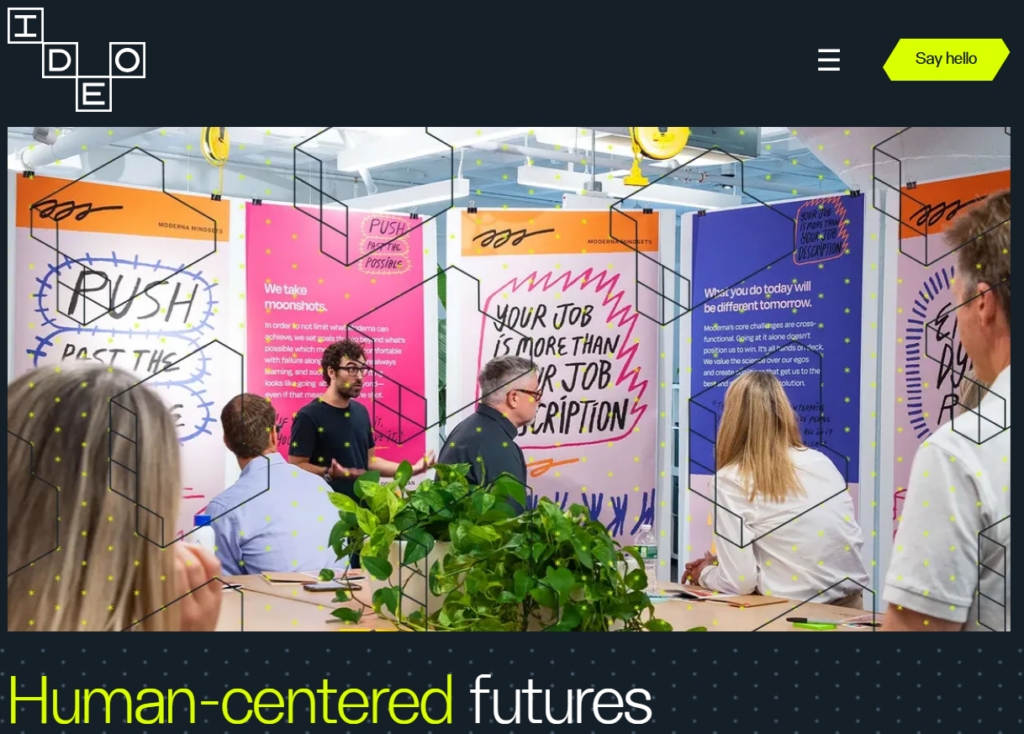
IDEO helped popularize design thinking as a mainstream business methodology, and its work continues to shape how large organizations approach product and service innovation, including projects with Canadian clients across health, finance, and consumer goods.
Firm Snapshot
| Detail | Information |
| Founders | David Kelley, Bill Moggridge, and Mike Nuttall |
| Year Established | 1991 |
| Headquarters | Palo Alto, California (global); project teams serve Canadian clients from US and remote offices |
| Team Size | Approximately 700 to 800 |
| Canada Presence | Project-based delivery for Canadian clients, without a standalone Canadian office |
Service Snapshot
IDEO’s work with Canadian clients covers:
- Human-centered design research to uncover unmet customer needs before a product is built
- Rapid prototyping to turn a concept into something a customer can react to within weeks
- Innovation capability training that leaves a client’s internal team able to run design thinking sessions independently
Core Strengths
- Design Thinking Origins: Few firms carry the same weight in shaping how large organizations think about human-centered design.
- Prototyping Depth: A strong internal capability for building physical and digital prototypes quickly.
- Cross-Sector Range: Experience spanning health care, financial services, consumer products, and public sector work.
Pros and Cons
| Pros | Cons |
| Deep design thinking pedigree and case history | No standalone Canadian office, so delivery is project-based |
| Strong prototyping and research capability | Premium pricing compared to boutique innovation firms |
| Broad cross-sector experience | Smaller footprint in the Canadian public sector than domestic firms |
Pricing
| Project Type | Typical Range (CAD) |
| Design research and concept sprint (4-6 weeks) | $120,000 to $300,000 |
| Full concept-to-prototype program | $350,000 to $1,500,000+ |
| Innovation capability training program | Quoted per scope |
Figures reflect general market ranges for firms of this size and are not published rates. Every quote depends on scope, team size, and project length.
Best Use Case
IDEO suits Canadian companies that need deep human-centered design research and a working prototype tested with real customers before committing to a full build.
Doblin (Deloitte)
Doblin built its name as an independent innovation strategy firm before joining Monitor Group and later Deloitte, and now operates as the innovation practice inside Monitor Deloitte, giving Canadian clients access to design thinking backed by Deloitte’s delivery scale.
Firm Snapshot
| Detail | Information |
| Founders | Larry Keeley and colleagues, named after design theorist Jay Doblin |
| Year Established | 1981 (acquired by Monitor Group in 2005 and by Deloitte in 2013) |
| Headquarters | Chicago, Illinois (now part of Deloitte’s global network); Toronto office for Canada |
| Team Size | Part of Deloitte’s approximately 460,000 global network |
| Canada Presence | Toronto, Montreal |
Service Snapshot
Doblin’s Canadian work covers:
- The Ten Types of Innovation framework, a structured method for mapping where a business can create value beyond its product alone
- Business model design for companies facing a disrupted or shifting industry
- Innovation portfolio management, helping large organizations balance core business work with new growth bets
Core Strengths
- Structured Method: The Ten Types of Innovation framework gives clients a repeatable way to look beyond product features alone.
- Deloitte Delivery Scale: Access to Deloitte’s broader technology and operations teams once a new concept is ready to build.
- Portfolio Management: Strong capability helping large enterprises manage a mix of core and new growth initiatives.
Pros and Cons
| Pros | Cons |
| Structured, well-documented innovation methodology | Can feel less independent than a pure boutique innovation firm |
| Access to Deloitte’s full delivery bench for build-out | Pricing scales toward Deloitte’s enterprise rate card |
| Strong portfolio management capability for large enterprises | Less suited to early-stage or smaller Canadian companies |
Pricing
| Project Type | Typical Range (CAD) |
| Innovation strategy diagnostic | $100,000 to $250,000 |
| Full business model design program | $350,000 to $1,800,000+ |
| Ongoing innovation portfolio advisory | Quoted per scope |
Best Use Case
Doblin fits large Canadian enterprises that want a structured, well-documented innovation method backed by the delivery capacity to build what gets designed.
Fjord (Accenture Song)
Fjord built its reputation on digital product and service design before its acquisition by Accenture, and now operates as part of Accenture Song, giving it access to large-scale delivery capacity alongside its design roots.
Firm Snapshot
| Detail | Information |
| Founders | Olof Schybergson, Mark Curtis, and Peter Ryman |
| Year Established | 2001 (acquired by Accenture in 2013) |
| Headquarters | Stockholm, Sweden (now part of Accenture’s global network); Toronto office for Canada |
| Team Size | Approximately 700 to 1,000 |
| Canada Presence | Toronto |
Service Snapshot
Fjord’s Canadian work covers:
- Digital product and service design for banking, retail, and telecom clients
- Customer journey mapping tied directly to a technology build plan
- Annual publication of the Fjord Trends report, a widely referenced view on emerging design and customer experience patterns
Core Strengths
- Design and Technology Pairing: Design recommendations come with a direct path into Accenture’s technology build teams.
- Customer Experience Depth: Strong track record designing digital products for banking, retail, and telecom clients.
- Global Trend Research: The Fjord Trends report gives clients an early view on shifting design and customer behaviour patterns.
Pros and Cons
| Pros | Cons |
| Strong pairing of design work with technology delivery | Design recommendations can lean toward an eventual Accenture build |
| Deep experience in banking, retail, and telecom design | Smaller standalone brand identity since the Accenture acquisition |
| Well-regarded trend research and design thinking content | Best fit skews toward larger enterprise budgets |
Pricing
| Project Type | Typical Range (CAD) |
| Digital product design sprint | $100,000 to $260,000 |
| Full product and service design program | $350,000 to $2,000,000+ |
| Ongoing design advisory retainer | Quoted per scope |
Best Use Case
Fjord suits Canadian banks, retailers, and telecom companies that need digital product design work paired directly with a path into full technology delivery.
frog (Capgemini Invent)
frog carries one of the longest design histories on this list, tracing back to the earliest days of industrial design consulting, and now operates as part of Capgemini Invent following its acquisition.
Firm Snapshot
| Detail | Information |
| Founder | Hartmut Esslinger |
| Year Established | 1969 (acquired by Capgemini in 2021) |
| Headquarters | Originally Germany, now part of Capgemini’s global network; Toronto office for Canada |
| Team Size | Approximately 1,500 |
| Canada Presence | Toronto |
Service Snapshot
frog’s Canadian work covers:
- Product and experience design spanning physical products, digital platforms, and services
- Innovation strategy tied to Capgemini’s broader engineering and cloud capabilities
- Brand and design system work for companies rebuilding their customer-facing identity
Core Strengths
- Design Heritage: One of the longest continuous track records in industrial and digital product design.
- Engineering Pairing: Access to Capgemini’s engineering teams once a design concept is ready to build.
- Range Across Product Types: Experience spanning physical products, software, and service design rather than one discipline alone.
Pros and Cons
| Pros | Cons |
| Deep, long-standing design heritage and case history | Independent identity has softened since the Capgemini acquisition |
| Strong pairing with engineering for full product builds | Best fit skews toward larger enterprise clients |
| Broad range across physical and digital design work | Smaller footprint in Canada than Fjord or IDEO |
Pricing
| Project Type | Typical Range (CAD) |
| Product or experience design sprint | $95,000 to $240,000 |
| Full design and engineering build program | $300,000 to $1,900,000+ |
| Ongoing design advisory retainer | Quoted per scope |
Best Use Case
frog fits Canadian companies that need product or experience design work with a direct path into full engineering delivery through Capgemini.
Innosight (Huron)
Innosight built its practice on the disruptive innovation research of Harvard Business School professor Clayton Christensen, and continues that focus as the innovation and growth strategy arm of Huron Consulting Group.
Firm Snapshot
| Detail | Information |
| Founders | Clayton Christensen and Mark W. Johnson |
| Year Established | 2000 (acquired by Huron Consulting Group in 2017) |
| Headquarters | Boston, Massachusetts (now part of Huron’s network); serves Canadian clients from US offices |
| Team Size | Approximately 90 to 150 |
| Canada Presence | Project-based delivery for Canadian clients, without a standalone Canadian office |
Service Snapshot
Innosight’s work with Canadian clients covers:
- Dual transformation programs, helping a company protect its core business while building a new growth engine
- Future-back strategy, building a vision of the market years out and working backward to set today’s priorities
- Disruption risk assessment for companies facing a new low-cost or unconventional competitor
Core Strengths
- Research-Backed Method: Built directly on Clayton Christensen’s disruptive innovation research, giving the firm strong academic grounding.
- Dual Transformation Framework: A structured way to fund new growth work without destabilizing the core business.
- Huron Delivery Support: Access to Huron’s broader operational and technology capabilities once a new business is ready to launch.
Pros and Cons
| Pros | Cons |
| Strong academic grounding in disruption theory | No standalone Canadian office |
| Structured dual transformation methodology | Smaller team size than the largest innovation practices |
| Access to Huron’s operational delivery capacity | Less design-led than firms such as IDEO or Fjord |
Pricing
| Project Type | Typical Range (CAD) |
| Disruption risk assessment | $90,000 to $220,000 |
| Full growth strategy and new business design program | $300,000 to $1,600,000+ |
| Ongoing innovation advisory retainer | Quoted per scope |
Best Use Case
Innosight suits Canadian companies facing disruption from a new competitor that need a structured method for protecting the core business while building a new growth engine.
Board of Innovation
Board of Innovation runs a global innovation practice out of Antwerp with a strong focus on business model design and corporate venture building, serving Canadian clients through remote and travel-based delivery.
Firm Snapshot
| Detail | Information |
| Founders | Nick De Mey and Philippe De Ridder |
| Year Established | 2009 |
| Headquarters | Antwerp, Belgium (with additional hubs including New York) |
| Team Size | Approximately 100 to 150 |
| Canada Presence | Project-based delivery for Canadian clients, without a standalone Canadian office |
Service Snapshot
Board of Innovation’s work with Canadian clients covers:
- Business model innovation, mapping new revenue streams beyond a company’s existing offer
- Corporate venture building, helping large organizations launch a new business unit or spinoff
- Human-centered design combined with rapid technology prototyping
Core Strengths
- Business Model Focus: A strong specialization in business model design rather than product design alone.
- Venture Building Experience: Direct experience helping large organizations launch and staff new business units.
- Global Perspective: Hubs across multiple continents, bringing cross-market pattern recognition to a Canadian project.
Pros and Cons
| Pros | Cons |
| Strong specialization in business model innovation | No standalone Canadian office |
| Direct experience building new corporate ventures | Smaller team size than the largest design firms |
| Cross-market perspective from a global hub network | Less brand recognition in Canada than IDEO or Fjord |
Pricing
| Project Type | Typical Range (CAD) |
| Business model design sprint | $80,000 to $200,000 |
| Full venture building program | $250,000 to $1,400,000+ |
| Ongoing innovation advisory retainer | Quoted per scope |
Best Use Case
Board of Innovation fits Canadian companies that want to design a new business model or launch a corporate venture rather than redesign an existing product alone.
Idea Couture (Cognizant)
Idea Couture built its reputation as a Toronto-founded an innovation and experience design firm before its acquisition by Cognizant, giving it genuine Canadian roots alongside global delivery capacity.
Firm Snapshot
| Detail | Information |
| Founders | Idris Mootee, Scott Friedmann, and Cheesan Chew |
| Year Established | 2007 (acquired by Cognizant in 2017) |
| Headquarters | Toronto and San Francisco (now part of Cognizant’s global network) |
| Team Size | Approximately 150 to 200 |
| Canada Presence | Toronto |
Service Snapshot
Idea Couture’s Canadian work covers:
- Foresight work and scenario planning to help clients prepare for multiple possible futures
- Experience design for consumer, financial services, and health care clients
- An innovation plan that connects design research directly to new business and product ideas
Core Strengths
- Toronto Origins: A genuine Canadian founding story, rare among the larger global innovation brands on this list.
- Foresight Capability: A dedicated foresight practice for clients planning several years ahead.
- Cognizant Delivery Access: Since the acquisition, access to Cognizant’s broader technology delivery network for full builds.
Pros and Cons
| Pros | Cons |
| Genuine Canadian founding story and Toronto presence | Smaller independent brand identity since the Cognizant acquisition |
| Strong foresight and scenario planning capability | Team size smaller than IDEO, Fjord, or frog |
| Access to Cognizant’s delivery network for full builds | Less domestic public sector work than CGI or Deloitte |
Pricing
| Project Type | Typical Range (CAD) |
| Foresight or design research sprint | $75,000 to $190,000 |
| Full innovation strategy and design program | $280,000 to $1,300,000+ |
| Ongoing innovation advisory retainer | Quoted per scope |
Best Use Case
Idea Couture suits Canadian companies that want a Toronto-founded innovation partner with strong foresight capability and access to Cognizant’s delivery network when a project moves to full build.
Rangle (a Bounteous company)
Rangle built its practice in Toronto around digital product innovation and modern web and mobile development, and now operates as part of Bounteous following its 2022 acquisition, giving Canadian clients access to a larger delivery network alongside its original engineering roots.
Firm Snapshot
| Detail | Information |
| Founder | Nick Van Weerdenburg |
| Year Established | 2013 (acquired by Bounteous in 2022) |
| Headquarters | Toronto, Canada (now part of Bounteous’s network) |
| Team Size | Approximately 250 |
| Canada Presence | Toronto |
Service Snapshot
Rangle’s Canadian work covers:
- Digital product innovation combining design, agile delivery, and modern JavaScript development
- Design system and platform launches for enterprise clients, often completed within a defined three to six month window
- Legacy application modernization paired with new product experimentation
Core Strengths
- Toronto Founding Story: Built and grown in Canada before its acquisition, giving it strong domestic delivery roots.
- Engineering-Led Innovation: A stronger emphasis on shipping working software than firms focused purely on research and concept design.
- Open-Source Toolkits: Proprietary tools built to speed up common design system and platform migration work.
Pros and Cons
| Pros | Cons |
| Strong Toronto founding story and domestic delivery roots | Independent brand identity has softened since the Bounteous acquisition |
| Engineering-led approach that ships working software quickly | Less focused on early-stage concept research than IDEO or Board of Innovation |
| Proprietary open-source toolkits that can speed up common builds | Smaller global footprint than the largest innovation practices |
Pricing
| Project Type | Typical Range (CAD) |
| Digital product research sprint | $65,000 to $170,000 |
| Full product innovation and build program | $220,000 to $1,200,000+ |
| Ongoing product advisory retainer | Quoted per scope |
Best Use Case
Rangle fits Canadian companies that want an innovation partner focused on shipping a working digital product quickly rather than an extended research and concept phase.
Bruce Mau Design
Bruce Mau Design has operated out of Toronto since the mid-1980s, applying a systems-level design approach to brand identity, environments, and large-scale innovation projects for Canadian and international clients.
Firm Snapshot
| Detail | Information |
| Founder | Bruce Mau |
| Year Established | 1985 |
| Headquarters | Toronto, Canada |
| Team Size | Approximately 50 to 60 |
| Canada Presence | Toronto |
Service Snapshot
Bruce Mau Design’s Canadian work covers:
- Brand identity design tied to a broader innovation or repositioning strategy
- Environmental and spatial design for organizations rethinking a physical space or public experience
- Systems-level design thinking, applying design principles to large, complex organizational challenges
Core Strengths
- Toronto Heritage: One of the longest-running Canadian design and innovation studios on this list.
- Systems-Level Thinking: A design philosophy that looks beyond a single product to the wider system it sits within.
- Brand and Environment Focus: Strong specialization in brand identity and environmental design rather than software product design.
Pros and Cons
| Pros | Cons |
| Long-running Toronto studio with deep design heritage | Smaller team size than the larger global innovation firms |
| Distinctive systems-level design philosophy | Less focused on software product innovation than Rangle or Fjord |
| Strong brand and environmental design capability | Single-city presence limits regional delivery options |
Pricing
| Project Type | Typical Range (CAD) |
| Brand or environment design sprint | $60,000 to $150,000 |
| Full brand and systems design program | $180,000 to $900,000+ |
| Ongoing design advisory retainer | Quoted per scope |
Best Use Case
Bruce Mau Design suits Canadian organizations that need brand identity or environmental design work grounded in a broader systems-level innovation approach.
?What If! (Accenture)
?What If! built its reputation helping large consumer brands develop new products and build an internal culture of innovation, and now operates as part of Accenture following its 2019 acquisition.
Firm Snapshot
| Detail | Information |
| Founders | Dave Allan and Matt Kingdon |
| Year Established | 1992 (acquired by Accenture in 2019) |
| Headquarters | London, UK (now part of Accenture’s global network); serves Canadian clients through Accenture’s Toronto office |
| Team Size | Approximately 200 to 500 |
| Canada Presence | Delivered through Accenture’s Toronto office |
Service Snapshot
?What If!’s work with Canadian clients covers:
- New product development for consumer goods, food and beverage, and retail brands
- Innovation culture training, teaching internal teams the tools to keep generating new ideas after the project ends
- Proprietary metrics for testing the commercial viability of a new product concept before launch
Core Strengths
- Consumer Product Focus: A strong track record specifically in food, beverage, and consumer goods innovation.
- Innovation Culture Training: A dedicated practice teaching internal teams how to sustain innovation after the consulting project ends.
- Accenture Delivery Access: Since the acquisition, access to Accenture’s broader technology and scale-up capabilities.
Pros and Cons
| Pros | Cons |
| Strong specialization in consumer product innovation | No standalone Canadian office outside Accenture’s network |
| Dedicated innovation culture training practice | Independent brand identity has softened since the Accenture acquisition |
| Proprietary commercial viability testing tools | Less suited to non-consumer sectors such as public sector or heavy industry |
Pricing
| Project Type | Typical Range (CAD) |
| New product development sprint | $85,000 to $210,000 |
| Full innovation and culture training program | $260,000 to $1,500,000+ |
| Ongoing innovation advisory retainer | Quoted per scope |
Best Use Case
?What If! suits Canadian consumer goods, food and beverage, and retail brands that need new product development paired with training to sustain an innovation culture internally.
Why Businesses Choose Pearl Lemon Consulting to Guide This Decision
Picking a name from the list above is only the first step. Pearl Lemon Consulting works alongside Canadian businesses to shortlist, vet, and manage the relationship with an innovation consulting partner, so the project produces a tested, viable idea rather than a workshop that generated excitement and nothing else.
| What We Bring | What It Means for You |
| Independent shortlisting | We are not paid by any firm on this list, so recommendations stay unbiased |
| Scope and RFP support | We help write the brief so proposals from different firms can be compared fairly |
| Cost benchmarking | We know typical market rates, so you avoid overpaying for a standard scope |
| Ongoing project oversight | We track deliverables against the original brief through the full project |
| Sector matching | We match your industry and company size to the firm best suited to it |
Frequently Asked Questions
How do you decide which innovation consulting firm fits our business? We match your sector, company size, and the specific innovation challenge you are facing against each firm’s track record and pricing tier before making a recommendation.
Can you help us connect a new concept with our existing CRM or ERP system? Yes, we review your current systems early in the process so any new product or service concept accounts for what your CRM or ERP can support.
What compliance steps do you take before recommending a firm? We check each firm’s regulatory history and sector experience relevant to your industry before adding them to a shortlist.
How do you report progress once a firm is on board? We provide a written update at each project milestone, covering deliverables completed against the original scope.
Can this process scale for a multi-year innovation program? Yes, we adjust the oversight model as a project grows from a single sprint into a multi-phase innovation program.
Do you customize the shortlist for smaller or mid-market companies? Yes, we weight the shortlist toward firms with pricing and team sizes suited to mid-market budgets when that fits your business.
What is the usual timeline from first call to firm selection? Most businesses move from an initial call to a signed project with a chosen firm within four to six weeks.
How do you measure whether the chosen firm delivered on its plan? We set KPI checkpoints tied to the original brief and review actual results against those targets at agreed intervals.
Do you work with businesses outside Toronto, Vancouver, Montreal, and Calgary? Yes, we support businesses across Canada, including smaller and regional markets not covered by every firm’s office network.
What does it cost to work with Pearl Lemon Consulting on this process? Fees depend on scope and are set out clearly before any work begins, with no charges hidden inside a later invoice.
Book Your Innovation Consulting Match Today
Picking the wrong innovation consulting partner costs a Canadian business months of workshops and a fee that produced ideas nobody built. Pearl Lemon Consulting helps you shortlist, vet, and manage the relationship with the right firm from this list, so the idea you pay for actually gets tested and launched.
Book a Consultation with Pearl Lemon Consulting and start the shortlisting process this week.