

Canadian businesses lose money every quarter to systems that do not talk to each other, security gaps nobody owns, and IT roadmaps that were never written down. An IT consulting company fixes that. The right partner brings governance frameworks, cloud know-how, and a delivery team that has already solved your problem for someone else, so you are not paying to have your own mistakes made twice.
Research methodology: See how we evaluate and compare consulting firms.
IT Consulting Services for Canadian Businesses
IT consulting services for businesses usually combine advisory and implementation. Typical work includes IT strategy, infrastructure, cloud, cybersecurity, enterprise systems, vendor selection, managed services, data, integration and technology governance. The right mix depends on whether the business needs to stabilise existing systems, reduce operating cost, improve security or build a more scalable technology environment.
For Canadian companies, an IT consulting partner should also be able to explain data residency, privacy, continuity, vendor concentration and how the recommended systems fit the capabilities of the internal team.
Business IT Consulting vs Managed IT Services
Business IT consulting focuses on decisions: which systems to keep, replace or integrate, how technology should support the operating model, and where investment will create measurable business value. Managed IT services focus more heavily on ongoing support, monitoring and maintenance. Some firms provide both, but buyers should be clear about whether they need strategic change, day-to-day operations or a combination of the two.
IT Consulting in Toronto and Across Canada
Businesses searching for IT consulting in Toronto or elsewhere in Canada should compare delivery model, sector experience and technical depth rather than location alone. Large migrations and systems programmes may require onsite workshops, while architecture, governance, security reviews and vendor selection can often be delivered effectively in a hybrid model. The strongest firms can show referenceable Canadian work, clear senior oversight and a documented handover plan.
Related technology guide: If your requirement is cloud migration, custom software, product engineering or AI adoption rather than core IT operations, compare our technology consulting firms in Canada.
Canada’s IT consulting market spans a few different types of firm: national systems integrators that run government-scale programs, regional managed IT providers that keep small and mid-sized businesses running day to day, and specialist consultancies built around one discipline, such as cybersecurity or data analytics. Picking the wrong category costs time. Picking the wrong company costs money.
This guide ranks 10 IT consulting companies with a genuine presence in Canada, covering what each one does, who they suit, what they tend to charge, and how their clients rate them. Pearl Lemon Consulting put this list together after reviewing public company records, Clutch and Google reviews, and each firm’s own service pages, so you can shortlist a partner without spending a week on research yourself.
The 10 Companies Covered in This Guide
- CGI Inc.
- Adastra Corporation
- Softchoice
- ThinkOn
- Konrad Group
- Info-Tech Research Group
- Packetlabs
- Nucleus Networks
- Denologix
- Cyber Unit
IT Consulting, Defined for Business Buyers
An IT consulting company advises on, builds, and sometimes operates the technology systems a business depends on: infrastructure, cloud platforms, cybersecurity, data and analytics, and custom software. Some firms only advise, handing over a plan for an internal team to execute. Others deliver end to end, staying on as the operational partner after the project closes. Most Canadian firms on this list sit somewhere between the two, offering advisory work alongside hands-on delivery.
Canada adds its own layer of complexity that a generic global vendor will not always understand well: PIPEDA at the federal level, Quebec’s Law 25, provincial health privacy statutes, and, for government and defence-adjacent clients, data residency rules that require Canadian-owned and Canadian-operated infrastructure. A consulting partner with real Canadian operations, rather than a satellite sales office, tends to handle these requirements with far less friction.
What Separates a Strong Consulting Partner From a Weak One
A good IT consulting company shows evidence of the following before you sign anything:
- Verified client outcomes. Case studies with real numbers, not adjectives, and third-party reviews on Clutch, Google, or G2 that a prospective client can check.
- Sector depth. Prior work in your industry, whether that is financial services, health care, manufacturing, or the public sector, each with its own compliance load.
- A named delivery team. Not just a sales contact. You want to know who is doing the work before the contract is signed.
- Clear pricing logic. Even when rates are quoted per project, the firm should be able to explain its hourly bands, minimum engagement size, and how change requests get billed.
- Certifications that matter. AWS, Microsoft, or Google Cloud partner tiers; SOC 2 or ISO 27001 for security-adjacent work; CREST for penetration testing.
- Retention. Long-tenured senior staff and multi-year client relationships are a better signal than headcount alone.
Canada’s Top 10 IT Consulting Firms at a Glance
| # | Company | Headquarters | Founded | Best Suited For | Typical Client Size |
| 1 | CGI Inc. | Montreal, QC | 1976 | Large-scale systems integration, government contracts | Enterprise, government |
| 2 | Adastra Corporation | Toronto, ON | Circa 2000 | Data, AI, and cloud modernization | Mid-market to enterprise |
| 3 | Softchoice | Toronto, ON | 1989 | Cloud, licensing, and IT asset management | Mid-market to enterprise |
| 4 | ThinkOn | Toronto, ON | 2013 | Canadian-owned cloud infrastructure and data sovereignty | SMB to enterprise, public sector |
| 5 | Konrad Group | Toronto, ON / New York | 2007 | Digital product design and AI-driven engineering | Mid-market to enterprise brands |
| 6 | Info-Tech Research Group | London, ON | 1997 | IT strategy research and advisory memberships | SMB to enterprise IT departments |
| 7 | Packetlabs | Toronto, ON | 2011 | Penetration testing and offensive security | Regulated mid-market to enterprise |
| 8 | Nucleus Networks | Vancouver, BC | 2001 | Managed IT services for growing SMBs | Small and mid-sized business |
| 9 | Denologix | Toronto, ON | 2003 | Business intelligence and data integration | Mid-market to enterprise |
| 10 | Cyber Unit | Vancouver, BC | 2013 | Cybersecurity and IT support for small business | Small business |
1. CGI Inc.
CGI is the largest home-grown IT consulting company in Canada and one of the largest independent IT and business consulting firms in the world. If a Canadian bank, airport, or federal department needs a system rebuilt or a decade-long IT outsourcing agreement, CGI is usually on the shortlist. Its size is both the appeal and the trade-off: clients get depth across almost every industry and technology stack, but smaller businesses may find the firm built for programs far larger than their own.
Founder Snapshot
| Detail | Information |
| Founders | Serge Godin and André Imbeau |
| Year Founded | 1976 |
| Headquarters | Montreal, Quebec |
| Team Size | Roughly 90,000 professionals worldwide |
| Client Rating | ★★★★★ (S&P/TSX 60 constituent, decades of government and enterprise references) |
The Value Behind the Name
CGI runs full IT and business consulting engagements: strategy, systems integration, application development, cybersecurity, and long-term IT outsourcing. Its member-ownership culture, where employees hold company shares, has kept senior staff in place for years at a time, which matters when a program runs longer than most vendors survive.
Core Strength 1: Systems Integration at Scale CGI has built and maintained mission-critical platforms for governments and large enterprises across four decades, including tax systems, health platforms, and financial infrastructure.
Core Strength 2: End-to-End IT Outsourcing Beyond advisory work, CGI takes on full IT operations, freeing internal teams from day-to-day infrastructure management.
Core Strength 3: Global Delivery With Canadian Roots With 400-plus offices in more than 40 countries, CGI blends Canadian data handling standards with a delivery network that can support multinational clients.
Pros and Cons
| Pros | Cons |
| Deep government and regulated-industry experience | Engagement minimums are out of reach for small business |
| Financial stability as a publicly traded company | Larger internal processes can slow decision-making |
| Broad service coverage under one contract | Less suited to fast, informal startup-style projects |
Pricing Section: CGI Inc.
| Engagement Type | Typical Starting Investment | Billing Model |
| IT strategy and roadmap advisory | $50,000+ CAD | Fixed-fee project |
| Systems integration programs | $500,000+ CAD | Milestone-based |
| Multi-year IT outsourcing | Custom quote | Annual contract |
Pricing is not published, since almost every engagement is scoped individually. Businesses under roughly 200 employees will typically find better value further down this list.
Best Fit
Government agencies, banks, insurers, and large enterprises that need a partner able to run programs measured in years, not weeks.
2. Adastra Corporation
Adastra built its reputation on data. What began as a data warehousing and analytics practice has grown into a full data, AI, and cloud consultancy with offices across North America and Europe. For a business trying to turn scattered spreadsheets and disconnected systems into something a leadership team can actually use, Adastra is one of the stronger Canadian options.
Founder Snapshot
| Detail | Information |
| Founders | Jan Cervinka, Jan Mrazek, and Petr Jech |
| Year Founded | Circa 2000 |
| Headquarters | Toronto, Ontario |
| Team Size | 1,000 to 5,000 employees globally |
| Client Rating | ★★★★☆ (strong technical praise; some clients note training resources could improve) |
The Value Behind the Name
Adastra’s practice covers data governance, cloud migration, and AI implementation, with recognized partner status from both AWS and Microsoft. Reviewers consistently point to the firm’s technical depth in GenAI and data governance projects, alongside long-term, repeat client relationships.
Core Strength 1: Data Governance and Modernization Adastra rebuilds fragmented data environments into governed, trustworthy systems that support reporting and decision-making.
Core Strength 2: Cloud Migration As an AWS Premier Tier partner, the firm handles infrastructure moves from legacy systems into managed cloud environments.
Core Strength 3: Applied AI Adastra has been recognized by AWS for data, analytics, and AI consulting, positioning it well for businesses starting their first serious AI project.
Pros and Cons
| Pros | Cons |
| Recognized AWS and Microsoft partner status | Recently acquired by a private equity firm, which can shift priorities |
| Strong technical reputation in data and AI | Better suited to mid-market and larger clients |
| Global delivery network for multinational projects | Onboarding for smaller businesses can take longer than boutique firms |
Pricing Section: Adastra Corporation
| Engagement Type | Typical Starting Investment | Billing Model |
| Data strategy assessment | $15,000 to $40,000 CAD | Fixed-fee |
| Cloud migration project | $75,000+ CAD | Project-based |
| Ongoing AI or data engineering retainer | $10,000+ CAD monthly | Retainer |
Best Fit
Mid-market and enterprise organizations that need to modernize data infrastructure or start an AI program without building a data team from scratch.
3. Softchoice
Softchoice has spent more than three decades helping Canadian businesses buy, license, and manage technology properly, which sounds unglamorous until you have seen how much money gets wasted on unused software seats and mismatched cloud contracts. The firm was acquired by U.S. technology solutions provider World Wide Technology in December 2024, so while it remains headquartered and staffed out of Toronto, it now operates as part of a larger American parent company.
Founder Snapshot
| Detail | Information |
| Founders | David Holgate and Jone Panavas |
| Year Founded | 1989 |
| Headquarters | Toronto, Ontario |
| Team Size | Over 2,500 employees |
| Client Rating | ★★★★☆ (long-standing reputation; now under U.S. ownership) |
The Value Behind the Name
Softchoice specializes in IT asset management, software licensing optimization, cloud adoption, and digital workplace support. It has spent years helping mid-sized businesses figure out exactly what they are paying for and why, then rebuilding the contract to match actual usage.
Core Strength 1: Licensing and Asset Management Few Canadian firms track software entitlements as closely as Softchoice, which routinely finds savings that offset a large share of the engagement cost.
Core Strength 2: Cloud Adoption Support Softchoice guides clients through Microsoft Azure, AWS, and Google Cloud migrations with a focus on cost control after go-live, not just the move itself.
Core Strength 3: Managed Services With over 685 managed services customers, the firm has the operational muscle to support day-to-day IT needs alongside project work.
Pros and Cons
| Pros | Cons |
| Deep licensing and cost-optimization expertise | Now U.S.-owned, which some Canadian buyers weigh carefully |
| Wide vendor partner network (Microsoft, AWS, Cisco) | Less specialized in one-off custom software builds |
| Established managed services track record | Larger org can mean less flexibility on contract terms |
Pricing Section: Softchoice
| Engagement Type | Typical Starting Investment | Billing Model |
| Licensing and cost audit | $10,000 to $25,000 CAD | Fixed-fee |
| Cloud migration | $50,000+ CAD | Project-based |
| Managed IT services | $2,000+ CAD monthly | Subscription |
Best Fit
Mid-sized to large organizations that want to cut wasted software spend while managing a cloud transition.
4. ThinkOn
ThinkOn occupies a category nearly all of its own: it is the only Canadian company authorized to service the federal government for protected cloud workloads, according to its own public statements, and it built its entire business on the idea that Canadian data should sit on Canadian-owned, Canadian-operated infrastructure. For any business, government agency, or regulated entity that treats data residency as a hard requirement rather than a nice-to-have, ThinkOn deserves a look.
Founder Snapshot
| Detail | Information |
| Founder | Craig McLellan |
| Year Founded | 2013 |
| Headquarters | Toronto, Ontario |
| Team Size | Small to mid-sized, with over 200 channel partners |
| Client Rating | ★★★★★ (recognized multiple years on the Growth 500 list of fastest-growing Canadian companies) |
The Value Behind the Name
ThinkOn delivers wholesale Infrastructure-as-a-Service, disaster recovery, and data protection through a channel-only model, meaning most clients access ThinkOn through a managed service provider partner rather than directly. It was recently selected to provide the infrastructure foundation for Canada’s Sovereign AI Platform, built for Shared Services Canada.
Core Strength 1: Data Sovereignty ThinkOn’s infrastructure is Canadian-owned and Canadian-operated, satisfying data residency requirements that many international cloud providers cannot meet.
Core Strength 2: Disaster Recovery as a Service The firm built its early reputation on backup and disaster recovery, giving it more operational maturity in this area than most younger cloud entrants.
Core Strength 3: Government-Grade Compliance ThinkOn’s work on federal government platforms signals a level of security and compliance rigor that smaller cloud providers rarely reach.
Pros and Cons
| Pros | Cons |
| Genuinely Canadian-owned infrastructure | Delivered mainly through partners, not always direct to end clients |
| Strong government and compliance credentials | Smaller footprint than global hyperscalers |
| Established disaster recovery expertise | Best value realized through an existing MSP relationship |
Pricing Section: ThinkOn
| Engagement Type | Typical Starting Investment | Billing Model |
| Infrastructure-as-a-Service (via partner) | Custom quote based on workload | Consumption-based |
| Disaster Recovery as a Service | $1,000+ CAD monthly | Subscription |
| Sovereign cloud consulting | Custom quote | Project-based |
Best Fit
Government bodies, regulated businesses, and any organization that needs a documented, defensible answer to “where exactly does our data live.”
5. Konrad Group
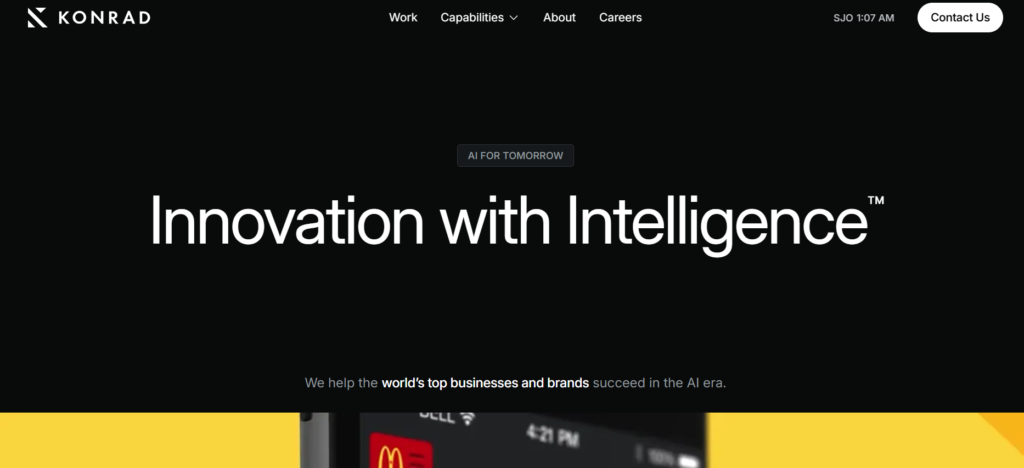
Konrad Group started as three university classmates building websites and grew into a digital consultancy trusted by Fortune 1000 brands, including names like McDonald’s, HP, and Kia. Where most firms on this list lead with infrastructure or security, Konrad leads with product design and engineering, making it the strongest pick here for businesses whose problem is a weak digital experience rather than a broken backend.
Founder Snapshot
| Detail | Information |
| Founders | Bill Konrad, Geordie Konrad, and Hooman Bahador |
| Year Founded | 2007 |
| Headquarters | Toronto, Ontario, with a New York office |
| Team Size | 400 to 600 employees |
| Client Rating | ★★★★★ (long-term relationships with major brands, including a near-decade partnership with CBC) |
The Value Behind the Name
Konrad combines strategy, UX and UI design, and software engineering to build digital products rather than just consult on them. Its acquisition of BrainStation, a digital training business, also gives clients access to workforce upskilling alongside project delivery.
Core Strength 1: Design-Led Development Konrad’s “Design-Driven Technology” approach puts user experience research ahead of code, which shows in the polish of its client-facing applications.
Core Strength 2: AI Product Integration Recent work includes AI-powered customer experience tools built with enterprise partners, reflecting a shift toward intelligent, context-aware product features.
Core Strength 3: Brand-Level Trust Nearly two decades of work with Fortune 1000 companies gives Konrad a portfolio few Canadian digital consultancies can match.
Pros and Cons
| Pros | Cons |
| Strong design and user experience expertise | Not the right fit for pure infrastructure or security work |
| Established Fortune 1000 client base | Premium pricing reflects brand-level positioning |
| In-house training arm (BrainStation) for staff upskilling | Smaller regional presence outside Toronto and New York |
Pricing Section: Konrad Group
| Engagement Type | Typical Starting Investment | Billing Model |
| Digital strategy sprint | $20,000 to $50,000 CAD | Fixed-fee |
| Product design and build | $150,000+ CAD | Project-based |
| Ongoing product support | $15,000+ CAD monthly | Retainer |
Best Fit
Mid-market and enterprise brands that need a customer-facing digital product rebuilt or an AI feature designed around real user behavior.
6. Info-Tech Research Group
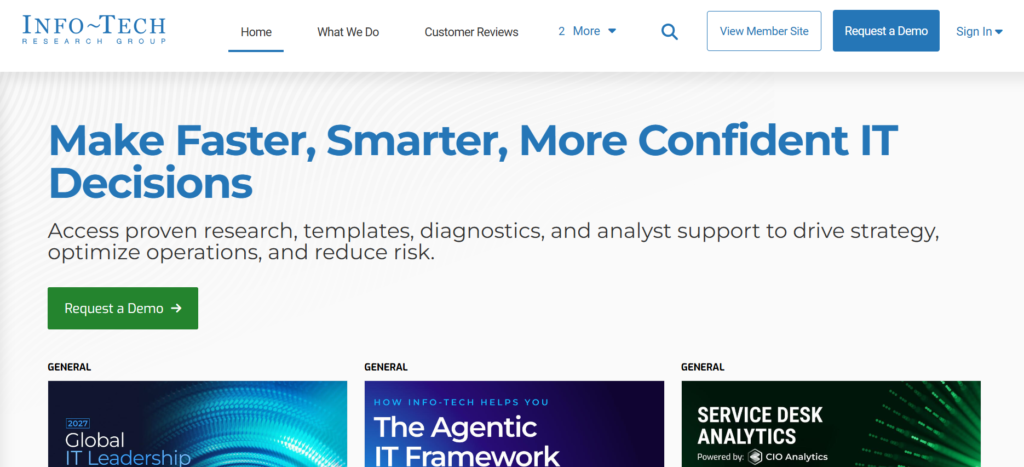
Info-Tech is not a traditional consulting company in the sense of showing up to build something for you. Instead, it sells research and advisory memberships to IT leaders, giving CIOs, IT managers, and increasingly HR and marketing leaders access to structured frameworks, templates, and one-on-one analyst guidance. For businesses that want a second opinion and a well-tested methodology rather than a full outsourced project team, this model can be more cost-effective than a traditional consultancy.
Founder Snapshot
| Detail | Information |
| Founder | Joel McLean |
| Year Founded | 1997 |
| Headquarters | London, Ontario |
| Team Size | Over 1,400 professionals globally |
| Client Rating | ★★★★★ (named Business of the Year, Large, at the 2025 London Chamber of Commerce Awards) |
The Value Behind the Name
Info-Tech serves more than 30,000 IT, HR, and marketing leaders worldwide through subscription-based research access, executive coaching, and workshop facilitation. It grew from a single-room operation faxing IT trend reports to a firm with offices across Canada, the U.S., the U.K., and Australia.
Core Strength 1: Structured IT Frameworks Decades of research produced repeatable methodologies for IT strategy, vendor selection, and performance measurement, tested across thousands of member organizations.
Core Strength 2: Executive Coaching Members get paired with a dedicated advisor, similar to the model described by Info-Tech’s own client stories, where a counselor becomes a long-term sounding board.
Core Strength 3: Cost-Effective Access to Expertise A membership model spreads the cost of deep research and advisory access across a subscription fee rather than a large one-off consulting bill.
Pros and Cons
| Pros | Cons |
| Lower entry cost than full-service consulting firms | Does not build or implement systems directly |
| Deep, repeatable research methodologies | Best value requires active member engagement, not passive access |
| Strong reputation built over nearly 30 years | Less suited to businesses needing hands-on delivery |
Pricing Section: Info-Tech Research Group
| Engagement Type | Typical Starting Investment | Billing Model |
| Standard research membership | $15,000 to $30,000 CAD annually | Subscription |
| Executive counselor add-on | Custom quote | Annual add-on |
| Workshop facilitation | $5,000+ CAD per session | Per-engagement |
Best Fit
IT, HR, and marketing leaders who want research-backed decision support and a coach on call, without hiring a delivery-focused consulting team.
7. Packetlabs
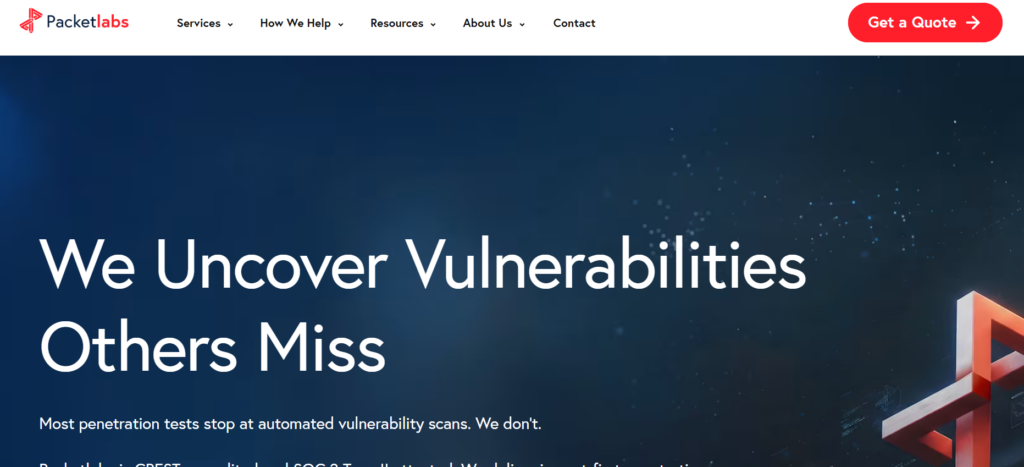
Packetlabs is a cybersecurity specialist built around one discipline: penetration testing. Where general IT consultancies often treat security as one service among many, Packetlabs has spent over a decade doing nothing else, and it shows in the depth of its methodology. The firm holds CREST accreditation and SOC 2 Type II attestation, two credentials that matter a great deal to regulated Canadian buyers.
Founder Snapshot
| Detail | Information |
| Founder | Richard Rogerson |
| Year Founded | 2011 |
| Headquarters | Toronto, Ontario (with a U.S. presence in San Francisco) |
| Team Size | 100 to 249 employees |
| Client Rating | ★★★★★ (5.0 out of 5 based on verified Google reviews) |
The Value Behind the Name
Packetlabs runs a 95 percent manual testing methodology, meaning consultants do the work themselves rather than relying on automated scanners. Every engagement is delivered by staff consultants with no subcontracting, and findings are checked by a second analyst before the report goes out, which cuts down on false positives that waste an internal security team’s time.
Core Strength 1: Manual, Adversary-Modeled Testing Packetlabs replicates how a real attacker would behave rather than running a generic vulnerability scan, uncovering risks automated tools tend to miss.
Core Strength 2: Regulatory Alignment The firm supports PCI DSS 4.0 segmentation testing, SOC 2 supporting penetration tests, and OSFI B-13 alignment for Canadian financial institutions.
Core Strength 3: Trusted Government Clients Packetlabs has worked with the Office of the Auditor General of Canada and multiple Canadian policing organizations, a strong signal of its handling of sensitive engagements.
Pros and Cons
| Pros | Cons |
| CREST and SOC 2 Type II accredited | Focused on penetration testing, not broader IT strategy |
| No subcontracting, all work done in-house | Premium hourly rate reflects specialist positioning |
| Strong public-sector and financial-services client list | Smaller firm size than diversified IT consultancies |
Pricing Section: Packetlabs
| Engagement Type | Typical Starting Investment | Billing Model |
| Web or mobile application penetration test | $10,000+ CAD | Fixed-fee per test |
| Network or infrastructure penetration test | $15,000+ CAD | Fixed-fee per test |
| Red team or purple team engagement | Custom quote | Project-based |
Reported average hourly rate: approximately $300 CAD per hour, with a minimum project budget generally starting around $1,000 to $10,000 for smaller-scope assessments.
Best Fit
Regulated mid-market and enterprise businesses, particularly in finance, health care, and government, that need penetration testing done by an accredited, Canadian-based team.
8. Nucleus Networks
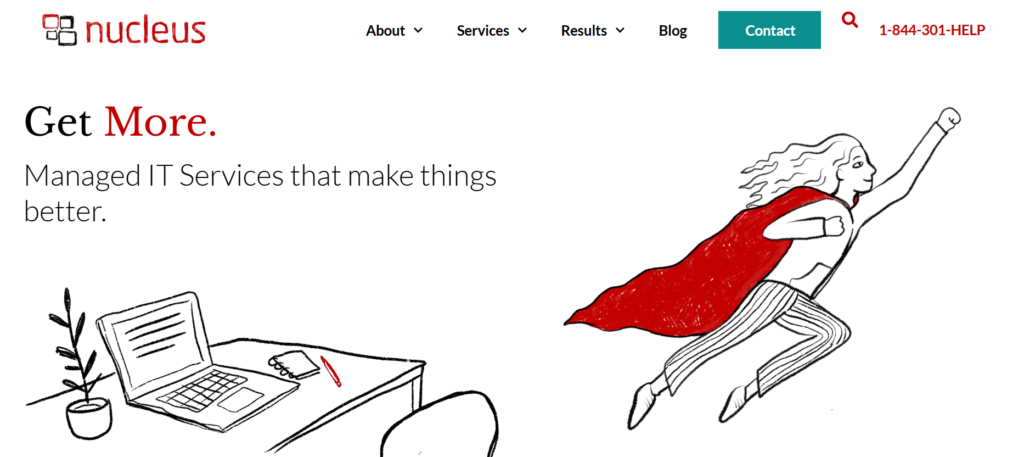
Nucleus Networks started in a Vancouver condo and has grown into a national managed IT services provider with a reputation strong enough to earn a spot on CRN’s 2026 Solution Provider 500 list. For small and mid-sized businesses that need a full outsourced IT department rather than a single project, Nucleus is one of the more consistently well-reviewed options in Western Canada.
Founder Snapshot
| Detail | Information |
| Founder | Gary Baerg |
| Year Founded | 2001 |
| Headquarters | Vancouver, British Columbia |
| Team Size | Roughly 90 employees |
| Client Rating | ★★★★★ (100 percent of reviewers report on-time delivery and strong communication) |
The Value Behind the Name
Nucleus pairs every client with a dedicated support team and a Client Success Manager, backed by 24/7 support lines, proactive cybersecurity, and virtual CIO advisory. The firm now supports over 200 organizations from offices in Vancouver, Victoria, Prince George, Calgary, and Toronto.
Core Strength 1: Dedicated Support Pods Clients are grouped into small support teams rather than a rotating help desk queue, which improves consistency and speeds up resolution.
Core Strength 2: Virtual CIO Advisory Nucleus offers long-range technology planning alongside day-to-day support, useful for businesses without an internal IT leadership role.
Core Strength 3: National Coverage From a Regional Base With offices spanning five Canadian cities, Nucleus can support multi-location businesses without the overhead of a national enterprise vendor.
Pros and Cons
| Pros | Cons |
| Consistently high marks for communication and reliability | Smaller team size limits capacity for very large enterprise programs |
| Personalized, pod-based support model | Primary strength is managed services rather than custom software |
| Recognized on CRN’s national Solution Provider list | Best suited to SMBs rather than large multinationals |
Pricing Section: Nucleus Networks
| Engagement Type | Typical Starting Investment | Billing Model |
| Managed IT services | $150 to $250 CAD per user, monthly | Subscription |
| IT strategy and vCIO advisory | $2,500+ CAD monthly | Retainer |
| One-time infrastructure project | $10,000+ CAD | Project-based |
Best Fit
Small and mid-sized businesses that want one accountable partner for both daily IT support and longer-term technology planning.
9. Denologix
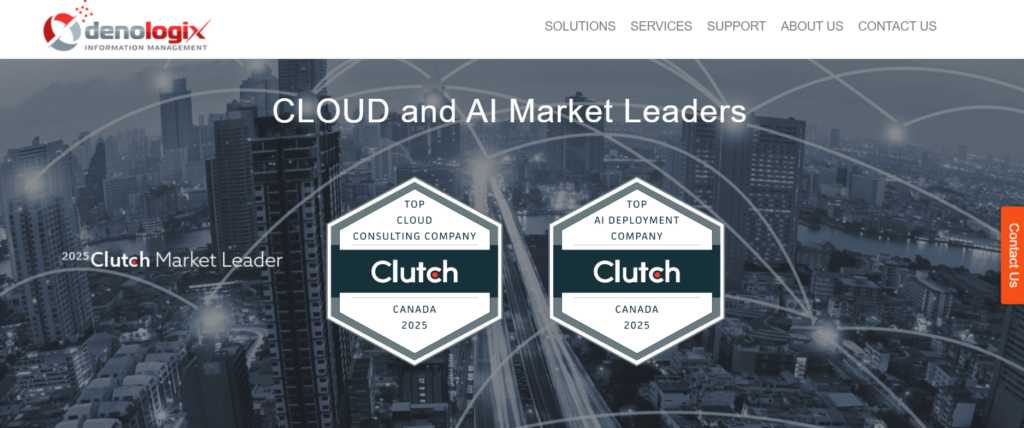
Denologix has spent more than two decades in one lane: business intelligence, big data, and analytics. While many firms on this list have expanded into broad IT consulting, Denologix has stayed close to its original focus on turning messy, siloed data into something an executive team can act on, working with well-known Canadian names such as major banks, insurers, and retailers.
Founder Snapshot
| Detail | Information |
| Founder / President | Shaz Ahmed |
| Year Founded | 2003 |
| Headquarters | Toronto, Ontario |
| Team Size | 20 to 50 employees |
| Client Rating | ★★★★★ (long-term client relationships cited as a defining strength in independent reviews) |
The Value Behind the Name
Denologix specializes in data quality, integration, and business intelligence platforms, partnering with SAS, IBM, SAP, and Oracle. It has been recognized as a market leader for data quality excellence and has appeared in industry analyst quadrants for big data and BI capability.
Core Strength 1: Data Quality and Integration Denologix cleans and unifies fragmented data sources into a single, trustworthy view, a step many analytics projects skip and later regret.
Core Strength 2: Flexible Delivery Models The firm offers onsite, home-shore, near-shore, and offshore delivery options, letting clients balance cost against the need for local presence.
Core Strength 3: Long-Tenured Client Relationships Reviewers specifically call out Denologix’s ability to sustain multi-year partnerships, a sign of consistent delivery quality over time.
Pros and Cons
| Pros | Cons |
| Deep specialization in data quality and BI | Smaller team than full-service IT consultancies |
| Established partnerships with major analytics vendors | Less suited to businesses needing broad IT infrastructure support |
| Strong track record with major Canadian enterprises | Public information on newer AI-specific offerings is limited |
Pricing Section: Denologix
| Engagement Type | Typical Starting Investment | Billing Model |
| Data quality assessment | $10,000+ CAD | Fixed-fee |
| BI or analytics platform build | $50,000+ CAD | Project-based |
| Ongoing analytics support | $150 to $199 CAD per hour | Hourly |
Minimum project size is generally reported at $10,000 CAD and above, with total project costs ranging from roughly $50,000 to well over $1 million depending on scope.
Best Fit
Mid-market and enterprise organizations that need clean, unified data before they can trust any reporting or AI initiative built on top of it.
10. Cyber Unit
Cyber Unit rounds out this list as the small-business specialist. Built out of Vancouver IT provider Techtone’s cybersecurity practice, the firm exists to make enterprise-style security accessible to businesses that could never afford a Fortune 500 security budget. For a local business with 10 to 100 employees that has never had a formal security assessment, Cyber Unit is a sensible starting point.
Founder Snapshot
| Detail | Information |
| Origin | Established as the cybersecurity division of Techtone |
| Year Founded | 2013 |
| Headquarters | Vancouver, British Columbia |
| Team Size | Small (under 50 employees) |
| Client Rating | ★★★★★ (100 percent of Clutch reviewers cite timely delivery and clear communication) |
The Value Behind the Name
Cyber Unit combines managed IT and cybersecurity under one roof, meaning the same team that monitors for threats can also fix the underlying IT issue, rather than handing clients off between separate vendors. Its services include 24/7 SOC monitoring, endpoint protection, email security, and incident response, built around British Columbia’s PIPA and Canada’s PIPEDA compliance requirements.
Core Strength 1: Integrated Security and IT Support Because security and IT sit under one team, incident response includes both containment and the technical fix, cutting down on handoff delays.
Core Strength 2: Small-Business Pricing Cyber Unit positions itself specifically for businesses that do not have Fortune 500 budgets, with packages designed around smaller headcounts.
Core Strength 3: Local Regulatory Familiarity The firm’s compliance work is built specifically around British Columbia’s PIPA alongside federal PIPEDA obligations, useful for BC-based businesses.
Pros and Cons
| Pros | Cons |
| Affordable entry point for small business security | Smaller scale than national or enterprise-focused firms |
| Combined IT and security team reduces handoff friction | Best suited to businesses under roughly 100 employees |
| Strong local reputation in Metro Vancouver | Limited public information on enterprise-scale case studies |
Pricing Section: Cyber Unit
| Engagement Type | Typical Starting Investment | Billing Model |
| Free initial security assessment | $0 | Complimentary |
| Managed cybersecurity package | $300 to $900 CAD monthly | Subscription |
| Combined IT and security support | Custom quote | Subscription |
Best Fit
Small businesses in British Columbia, or anywhere in Canada, that need a first real cybersecurity program without an enterprise-sized budget.
Choosing Your Canadian IT Consulting Partner
The right choice on this list depends almost entirely on the size of your problem and the size of your business. CGI and Adastra suit organizations running programs with real budget and multi-year timelines. Konrad Group fits a business whose weak point is the customer-facing product. Info-Tech Research Group suits IT leaders who want research and coaching rather than delivery. Packetlabs and Cyber Unit both cover security, at very different scales. Nucleus Networks and Softchoice fit businesses that need ongoing, reliable IT operations. ThinkOn and Denologix fill specialist niches around data sovereignty and analytics.
Before signing with any of them, ask for three references from businesses close to your own size and industry, and read their independent reviews rather than only the case studies published on their own site.
Why Businesses Partner With Pearl Lemon Consulting
Comparing 10 companies is useful, but most businesses still need a second opinion before committing to a six-figure contract. Pearl Lemon Consulting works alongside Canadian businesses to define the IT problem clearly, shortlist the right type of partner, and check delivery quality once a contract is underway, so the decision does not rest on a sales pitch alone.
| What You Get | Why It Matters |
| Independent shortlisting, not a referral kickback arrangement | You get a recommendation based on fit, not commission |
| A written scope document before you talk to any vendor | Vendors quote against a clear brief instead of guessing your needs |
| Reference checks on your shortlisted firms | You hear from real clients before you sign, not after |
| Ongoing delivery oversight | Someone on your side tracks whether the vendor is hitting milestones |
| Compliance review for PIPEDA, Law 25, and sector-specific rules | You avoid signing a contract that creates a regulatory gap |
Common Questions Before You Sign a Consulting Agreement
Does a Canadian IT consulting firm connect with our existing CRM and ERP systems? Most established firms on this list, including Adastra, Denologix, and CGI, have integrated with major CRM and ERP platforms such as Salesforce, Microsoft Dynamics, and SAP as a standard part of past engagements.
How does a consulting firm handle compliance with PIPEDA or provincial privacy law? A qualified firm builds compliance checkpoints into the project plan from the start, rather than treating it as a final-stage review before launch.
What does a typical reporting structure look like during a project? Expect a weekly or biweekly status update, a shared project tracker, and a formal milestone review at each major phase.
Can these firms scale a solution if our business grows quickly? Firms like ThinkOn, Softchoice, and CGI are built around consumption-based or tiered pricing models designed specifically to expand alongside growth.
How much customization is realistic within a standard engagement? Most firms scope a base solution first, then price customization separately once the core requirements are confirmed.
What is a realistic timeline for a mid-sized IT consulting project? A focused project, such as a cloud migration or a security assessment, typically runs 6 to 16 weeks, while larger systems integration work can run 6 months or longer.
How are project KPIs measured once work begins? Reputable firms agree on measurable KPIs, such as system uptime, ticket resolution time, or data accuracy rate, before the contract is signed, not after delivery.
Do smaller Canadian businesses get the same level of service as enterprise clients? Firms like Nucleus Networks and Cyber Unit are built specifically around SMB budgets and headcounts, so service quality is not simply scaled down from an enterprise offering.
What happens if a project goes over budget or timeline? A properly scoped contract includes a change-request process, so scope changes are priced and approved before work continues, rather than surfacing as a surprise invoice.
Is a fixed-fee or hourly billing model better for our business? Fixed-fee suits well-defined projects with a clear end point, while hourly billing suits ongoing or exploratory work where scope may shift.
Book a Consultation With Pearl Lemon Consulting
You do not need to guess which of these 10 companies fits your business, or spend another quarter finding out the hard way. Pearl Lemon Consulting will review your current systems, define what a strong outcome actually looks like for your business, and help you sign with the right Canadian IT consulting partner using a scope document that protects your budget from day one.
Schedule a discovery call with Pearl Lemon Consulting and start your next IT project with a clear plan instead of a guess.